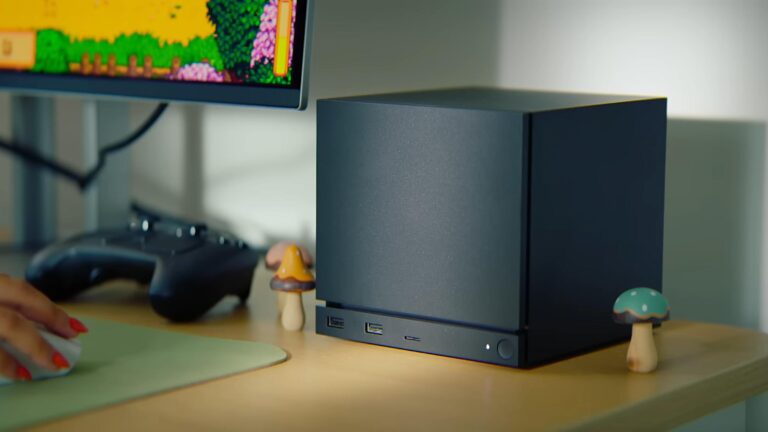
The Steam Machine is back, but not in the way we remember. Valve has moved away from the 2014 era of licensed third party hardware, opting instead to build its own dedicated living room PC. After a surprise announcement in late 2025, we are looking at a 2026 launch for a device that aims to bring the Steam Deck experience to the big screen. It is a utilitarian piece of hardware: a black box measuring roughly 6 inches [15 cm] on all sides: designed to function as a bridge between the flexibility of a PC and the convenience of a console.
Under the Hood
Inside the chassis, Valve has packed a semi-custom AMD Zen 4 CPU and RDNA3 GPU. While this setup is objectively more powerful than the aging handheld hardware from 2022, Valve is keeping expectations grounded. The company suggests that while many titles can reach 4K resolution at 60FPS, this often relies on FidelityFX Super Resolution (FSR) upscaling. For a general viewer, this means the hardware uses software “tricks” to sharpen a lower-resolution image to fit a 4K TV. It is a practical solution for a compact box, though Digital Foundry has noted that the 8GB of dedicated video memory (VRAM) may limit performance in high-end titles compared to the current generation of consoles.
Portability and Ports: At 2.7 pounds [1.2 kg] (estimated), the box is compact but stationary. The rear features DisplayPort 1.4 and HDMI 2.0, allowing it to connect to modern TVs or monitors.
Input Options: Beyond the four USB-A ports for wired peripherals, there is a built-in 2.4GHz adapter specifically for the new Steam Controller.
Thermal Design: The back is dominated by a fan grille to manage the heat generated by the AMD chip, a necessity for maintaining performance during long gaming sessions.
The Software Translation Layer
The Steam Machine runs on SteamOS, a Linux-based operating system. To play games designed for Windows, it uses a compatibility layer called Proton. This software essentially translates Windows instructions into a language Linux understands. For most users, this process is invisible, but it can be a hurdle for competitive games that use specific anti-cheat software. Valve expects the increased popularity of a home console will encourage developers to fix these compatibility gaps, making more multiplayer titles playable in the living room without a Windows license.
Pricing Reality and Availability
Valve has yet to confirm a final price, but do not expect the aggressive $399 entry point we saw with the original Steam Deck. The tech industry is currently grappling with a shortage of memory components, largely driven by the demand for AI hardware. This has pushed prices upward across the board. Valve has already mentioned that these rising costs are affecting their planning, suggesting the Steam Machine will be positioned as a premium device closer to the price of a mid-range gaming PC rather than a budget console.
Steam Machine’s pricing is comparable to a PC with similar specs and would be very competitive with a PC you could build yourself from parts.
The device is slated for a 2026 release, likely in the first half of the year. It will launch alongside a new Steam Controller and a wireless VR headset called the Steam Frame. While the “looks over substance” trap is always a risk with compact PCs, Valve’s track record with the Steam Deck suggests they are prioritizing a cohesive software experience over flashy, non-functional design. We will see if that balance holds when the hardware finally ships.