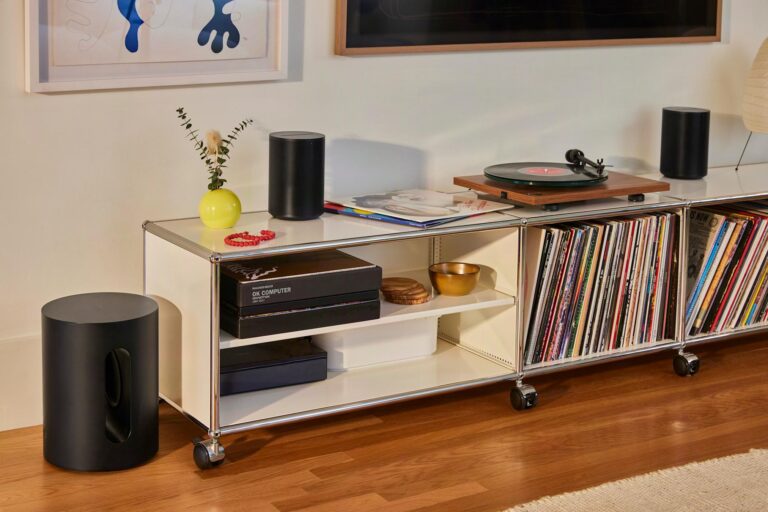
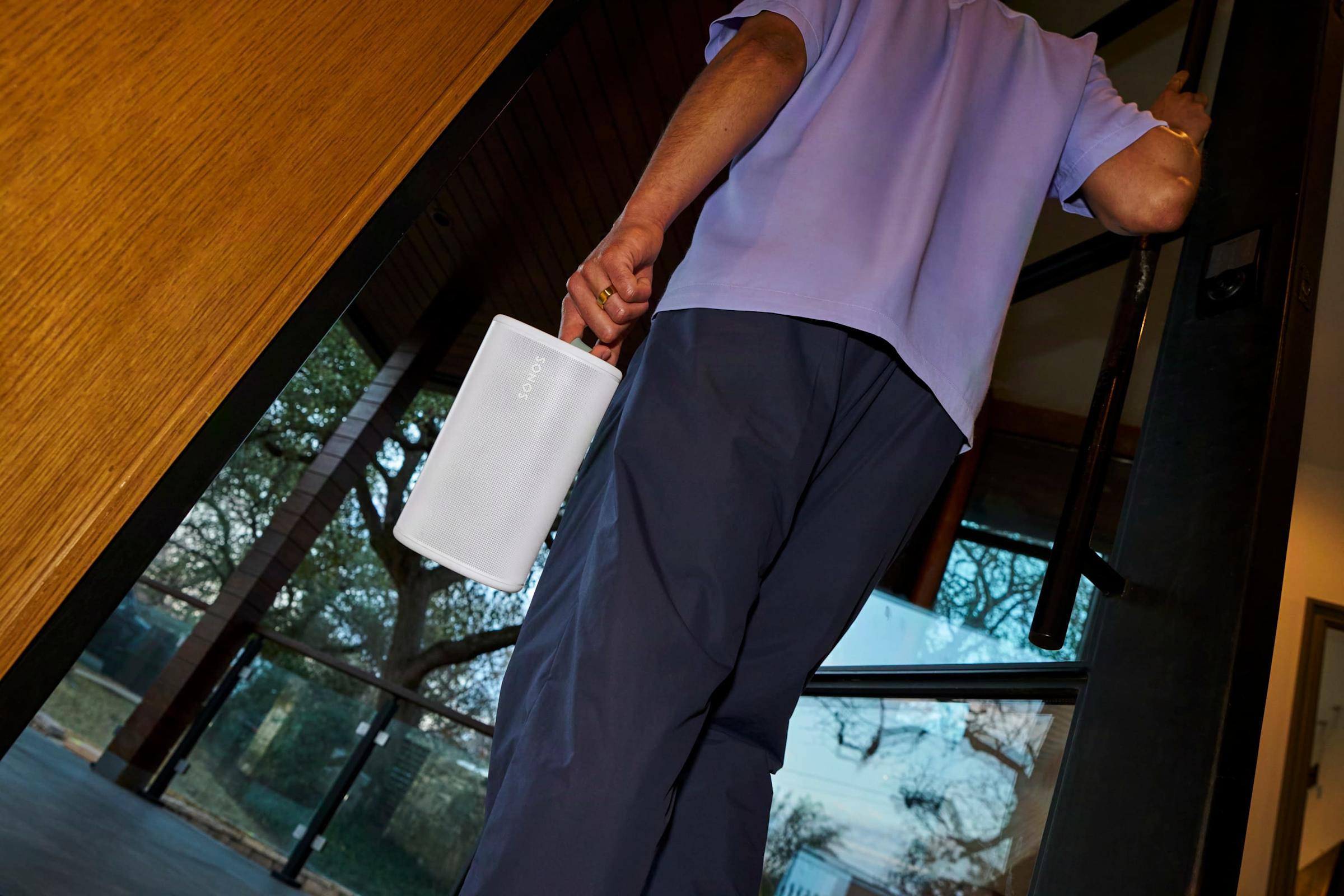
Sonos is attempting a reset. After a difficult 2024 defined by a poorly received app overhaul, the company has announced its first new hardware in two years. The standout is the Sonos Play, a $299 [€283] portable speaker that revives a classic name but introduces a new physical profile. Positioned between the ultra-portable Roam 2 and the heavy-duty Move 2, the Play looks to be the “middle ground” option for users who want a speaker that is easy to move but large enough to produce actual fidelity.
Portable Design and Durability
The Play measures 7.6 inches [19.3 cm] tall and 4.4 inches [11.2 cm] wide, with a depth of only 3 inches [7.6 cm]. This makes it notably thinner than the Era 100, which has a depth of over 5 inches [12.7 cm]. Weighing less than 3 pounds [1.36 kg], it is significantly lighter than the 6.5 pound [2.95 kg] Move 2. For the user, this weight difference is the deciding factor between a speaker you can comfortably carry to the patio and one that feels like a chore to move. Despite the lighter build, it carries an IP67 rating: it is dustproof and can survive being submerged in a meter [3.3 feet] of water for 30 minutes. This is a functional necessity for a device meant to live near a pool or in a dusty workshop.
Audio Architecture and Bluetooth Grouping
The internal components are a close match to the Era 100, featuring two tweeters angled at 90 degrees for stereo separation and a single midwoofer. To compensate for its smaller enclosure, Sonos added two passive radiators to bolster the bass. This should provide a fuller sound than the Roam 2, which often struggles to fill a room. A new software trick allows for Bluetooth grouping: you can pair one Play to your phone and then link up to three more Play or Move 2 speakers via Bluetooth. This is a smart solution for outdoor areas where your home Wi-Fi signal might be weak or non-existent.
The Era 100 SL and Everyday Utility
Alongside the Play, Sonos introduced the Era 100 SL for $189 [€179]. It is identical to the standard Era 100 but removes the microphones entirely. For those who do not use voice assistants or have privacy concerns regarding always-on mics, this is a clear “form follows function” choice that also saves $30 [€28]. The Play also features a USB-C port that supports line-in and Ethernet via adapters, and it can even charge your phone in a pinch. However, Sonos has decided not to include a USB-C power brick in the box, which is an annoying omission for a $299 [€283] product.
Studio Display XDR is a huge leap forward for XDR technology, with a mini-LED backlight, 2000 nits of peak HDR brightness, advanced color accuracy, and a 120Hz refresh rate, transforming workflows.
The Sonos Play and Era 100 SL are available for pre-order now and will ship on March 31. After a year of software apologies, these products represent Sonos getting back to its core competency: solid hardware build quality and a reliable ecosystem. The Play, with its wireless charging base and removable grab loop, feels like a well-considered addition to a lineup that previously had a very large gap in its portable offerings.